Magical AI Crayons
Vibecoding has gotten so good it feels like magic, but we still haven’t seen the true potential of AI-powered creative tools built for the masses. AI Crayons will remind us that play is the soul of creativity.
Vibecoding has gotten so good that it feels like magic, yet we still haven’t seen the true potential of AI-powered creative tools for the masses. New UX patterns, new media formats, new means of distribution - and above all, new ways to have fun - will revolutionize software and entertainment. I call this class of tool AI Crayons.
New Magic, Old Spells
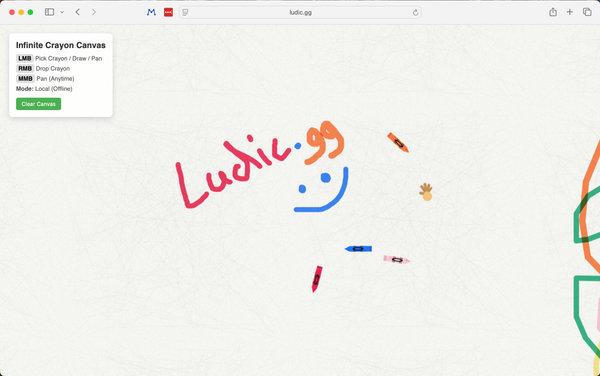
Like many people, I spent my holiday vibecoding and repeatedly having my mind blown by the capabilities of modern agents. In just the last few weeks I’ve built a personal fitness tracker, a graph-based reading list, a toy drawing canvas, and even tools to help me make more tools. As a non-developer, this has been the greatest gift to my creativity I’ve ever been given, and starting projects/buying domain names has become a bit of an addiction. The learning itself has been its own joy - suddenly I’m engrossed in Youtube videos about CI/CD, version control, and pipelines named after Simpsons characters. What AI offers me for the first time is the belief that I can turn any idea into reality. It’s a gift so incredible that, like a magic ring of power, I haven’t been able to put it down.
But that is not enough for me. I want everyone to have this power. I want my normie friends to have this power. I want my mother to have this power. I want my 97-year-old grandmother to have this power. Yet, despite my inability to shut up about this new ring I’ve found, none of those people are casting spells with me, and it’s not hard to see why. There is still an assumption that users will speak the incantations of the old magic - my mother will never learn the phrases ‘git’, ‘json’ or ‘md’. She will certainly never type ‘pnpm test’. Modern AI is the greatest achievement in the history of creativity tools - and I want more. I want a consumer-oriented tool that makes everyone feel as creative and empowered as I do. I want AI tools that feel as simple as playing with crayons.
Crayons for Everyone
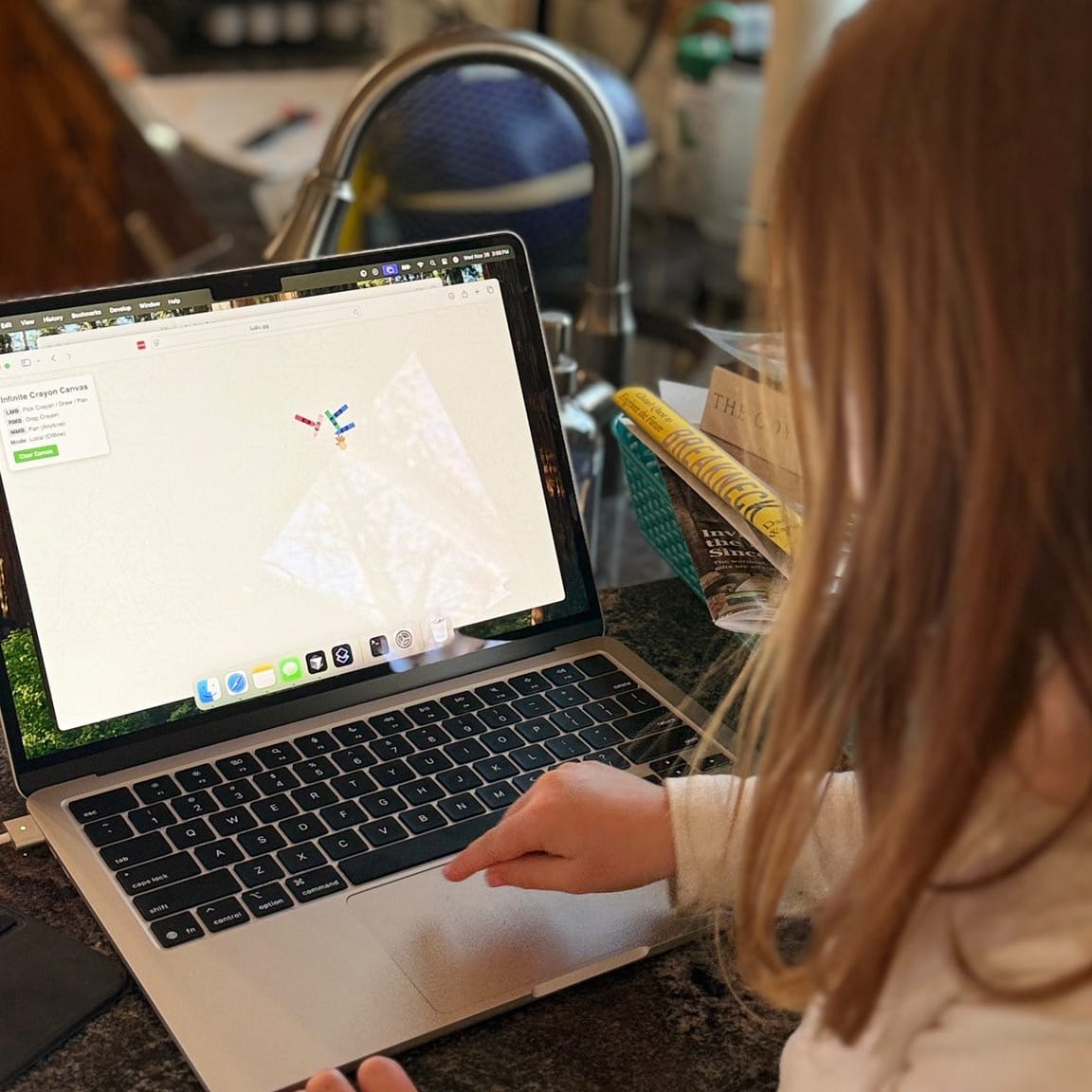
Crayons are a triumph of the democratization of art. At the height of the Renaissance, Leonardo da Vinci had to be a master chemist to break free from the limited pigments available from natural materials. Now, every child has access to over 100 colors in a box that costs their parents less than a sandwich. Professional artists may scoff at the lowly crayon, but is there a more common art tool in the American home? Every household with a child likely owns more pieces of colorful art than a workshop could produce throughout the entire Renaissance. Their beauty lies not merely in their variety but in their simplicity - hand a box to a toddler and without instruction they will put them to use immediately.
The average crayon drawing will not sell for thousands of dollars, yet Crayola generates ~$500M+ per year and the best craftsmen are capable of shockingly impressive works. And the best thing about crayons is that they are FUN. Through playm we learn how to express ourselves and structure our perceptions of the world. Crucially, crayons also teach us about the role of human creators in the creation of art. Two mothers can each own handmade Christmas cards overflowing with pre-schematic shapes of every imaginable color, both of which are prized possessions, neither of which would have any value to the other were they to be traded. These bespoke masterpieces remind us that art’s value is not derived from its fidelity, that who creates the art can be more differentiating than the execution, and that the feelings of connection that art provides transcend the works themselves.
Digital Crayons
I use Cursor obsessively and have seen professional tools adopted heavily by game studios, but the reality is that while amazing businesses are being built in AI-native B2B SaaS, there is still a clear lack of culturally dominant winners in creativity-oriented consumer AI. I believe “AI Crayons” are the answer, and so for new consumer applications I propose the Crayon Test:
- Does the creation process work right out of the box with minimal instruction?
- Is it fun to create?
- Can creations be easily shared with the people closest to you?
- Can the best creations attract extreme attention to their creator for being differentiatedly gifted?
- Do the outputs help people connect over shared experiences?
Instagram is a pre-AI Digital Crayon: The app is much easier to use than professional photo editing software; it’s decidedly for ‘amateurs’, yet photography on instagram dwarfs the output of every fine art studio in the world; children figure out how to use it without instruction every day; the average insta post is forgotten within 24 hours and yet the platform generates billions in annual revenue; people certainly have fun posting on Instagram.
In the AI era, ChatGPT is the first product to approach something similar. Given its broad utility and lack of a focus on creativity, I don’t consider it a Crayon, but its success with consumers points in the right direction: It’s easier than googling/scrolling through reddit, etc; professionals would scoff at a fully Chat-written article yet billions of prompts are sent and answered every day; the blinking cursor couldn’t be an easier interface to understand for a new user; no one prompt is inherently that valuable, but the sum are worth over $10B/yr to OpenAI. Like Instagram, it crossed the chasm into cultural dominance by riding simplicity.
Designing AI Crayons
So how do you design AI Crayons? One lesson comes from the world of video games. While at Maxis, Chaim Gingold designed the delightful creature creator system for the Spore; the system was the best thing about the game and has had an enduring impact on design that far outpaces the commercial success of the title. In 2008 he delivered an exceptional GDC talk (slides separate from audio), that inspired the name of this essay and much of my own design philosophy (I was very fortunate to have Gingold work with us briefly in the early days of Liminal).
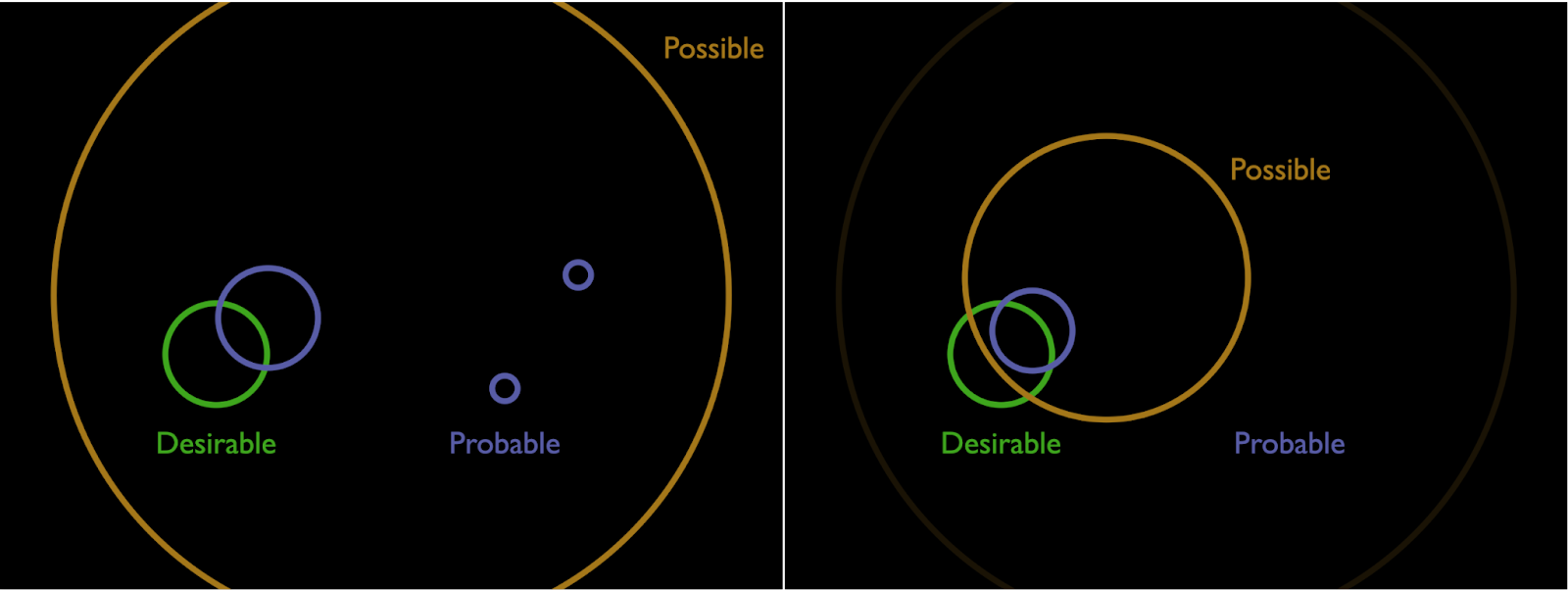
Gingold calls out how the first instinct of developers working on creativity tools is to make them massively powerful so that they can do anything the user wants. But this is a trap - it is the constraints of the software that shape the solution space. Tools that can do anything will, much of it will be bad, and amateurs will find themselves disappointed with their results and demotivated to continue.
The craft in designing the tools is to simplify the possibility space in order to increase the likelihood that the creator ends with a product they are proud of. The goal is to overlap the distribution space of Probable outputs for the average user with Desirable outputs they will be happy with - acknowledging that this will leave some Desirable outcomes outside the space of what is Possible with the tool.
Crayons do this by compressing their developers’ expert knowledge into normie-readable idioms. As DSLRs exploded in popularity, professional and prosumer photographers needed better software for editing the growing number of RAW photos they were taking. Adobe, already the biggest player in the image editing space with Photoshop, introduced Lightroom in 2007. Lightroom solved new problems in familiar ways, clearly showing its Photoshop heritage. This led to rapid adoption among professional and enthusiast photographers. In the five years following its launch, Lightroom was a massive success, becoming THE way to edit photos. Importantly, the software was a) adding value to complements that were seeing rapid technological advancement in quality and price (DSLR hardware) and b) lowering the floor to welcome new non-professional enthusiasts attracted to the ease of those complementary tools and the novel distribution methods that rewarded their new skills (Myspace, Facebook). And then…. Instagram happened.
Critically, Instagram did not abandon the technical principles undergirding Adobe Lightroom. Rather, all of the manipulable elements at the core of the pro software - the tweaking of shadows, contrast, highlights, color temperature - remain in filters, just converted from tone curves meticulously modified for each image to presets made once by the developer and applied over and over to each photo. AI will take this concept to the extreme with infinite ‘filters’ created on demand by the AI at runtime. These constrained possibility spaces are not static in time - as users become more familiar with the tools and internalize their grammar, complexity can be added over time to expand the space of what is Possible to create.
The AI Crayons mantra: Do less, more intuitively.
Going Beyond Prompts
The answer is not to be found in purely writing prompts. I liken modern text-based interfaces to a team building activity from hell - imagine you have a diagram of a Lego house in front of you and your team member is on the opposite side of a one-way window. They have to build exactly what you are looking for, and the only communication allowed is slipping little pieces of paper with written instructions through a slot into their room, even simple pointing is disallowed. No one would rationally design collaboration this way, and yet much of the current paradigm revolves around this dynamic.

The visual editor attractor that has captured the Cursor/Replit Design/Figma Make class of solutions, with their dual interface of text/clickable elements, seem closest, though still not Crayons level. I remain equally skeptical that my mother is interested in learning node graphs.
New Proofs of Work
Interfaces are the beginning, but AI Crayons will need to be more than novel affordances. Instagram was much more than just elegant filter software. The product handled photo capture, editing, sharing, and liking, popularizing an entirely new format by bundling creation with distribution and consumption.
In his seminal piece on the rise of new social networks, Eugene Wei highlighted the importance of the proof of work in creating new markets for social status. All new social media apps break through by creating a new skill vector for individuals to differentiate themselves in return for status - Twitter with fortune-cookie length humor, Tiktok with captivating entertainment in under 15 seconds. AI Crayons will need to provide an original proof of work, and a new format for distribution, in order to take off. Herein lies the challenge for Sora. While it’s very easy to use and can make some excellent content, the format competes too directly with existing short-form video distribution channels to earn its own proper place as an AI Crayon.
Hopes and Fears for AI Crayons and Community
What spaces are the most susceptible to drowning in a second wave? Cursor/Claude Code are already operating on a much larger scale than Lightroom ever was, as the developer community was already much larger and more economically important than the professional photography community, but there are still echoes of the past for them to learn from. For the new batch of image/video editors like Runway, this lesson may be existential. In gaming, Unity/Roblox map well to Final Cut Pro - they helped to lower the barrier to entry for a new type of developer riding a wave of novel distribution, but they are fundamentally not built for a crayons-like interface. Of the two, I’d bet on Roblox to innovate their way out of the issue. Unlike Unity, they are still led by a technical founder with a healthy dose of paranoia and have already made extensive and impressive investments in AI. The challenge will be overcoming their very libertarian engineering culture to innovate on Crayons, not just tech for their current audience of creators. In the meantime, their distribution is dominant, but as Marc Andreessen once said “Go ask the MySpace guys how their network effect is going.”
Far more interesting than predicting the doom of specific businesses though is asking what new experiences will become possible for consumers and how that will impact culture. As each wave gets bigger and bigger, winners of previous waves can still grow, and no B2B SaaS company needs to fail for new formats to radically rewrite the ways we discover art and connect with our loved ones. I am excited about personalized software, storytelling, and gaming as likely markets for AI Crayons.
Apps like Wabi are exploring novel approaches to UGC apps, making software truly personal. There are many software-shaped problems that have previously not been economically worth solving. As the friction to create these solutions approaches zero, we should expect a flood of bespoke tools to fill the gaps.
The combination of simplified interfaces and one-click distribution fits within the crayons philosophy, though I do have some concerns about the dark side of individualized software. One strong form often put forth for the ‘promise’ of the AI-personalized future is the hyper-curated feed where every app, tweet, tv show, and song is bespoke manufactured Just-In-Time, to your exact tastes. This Wall-E-esque vision strikes me as an extension of the worst aspects of modern technology, where the convenience they offer often comes at the cost of increasing feelings of isolation.
My utopia is one where AI goes beyond serving us the next dopamine hit and instead helps us to create communities we would never otherwise find, giving us all residence in the online city that most enriches our lives. The best version of Wabi-likes will lean into community building and human connection, for both app creation and consumption.
Beyond personalized software, I am always drawn towards new formats for storytelling. I know of at least one well-known Hollywood filmmaker exploring this space, and exciting early experiments in this direction abound online. By the end of this decade, I expect a single individual to produce a Hollywood-quality blockbuster, and by then I expect that a new AI Crayon will emerge that enables anyone to create and share interactive, immersive worlds, minting new celebrity creators in the process. I also expect communal creativity to be at the forefront. The convergence of community-owned IP and AI-generated memes like italian brainrot point to a very cool, very weird future of communal storytelling. Sharing tales around a fire is perhaps the oldest human tradition, those tales guide culture more than we realize, and attachment to specific worlds and creators can often define our identities and the tribes to which we belong.
My favorite pre-AI digital Crayon is Minecraft. To my eye, it passes all of the above with flying colors, as did its physical world antecedent made for ages 1-99. After four years working on Liminal, I have strong thoughts on how AI Crayons will build on this model. Creation will be joyful, multiplayer, and global. I also believe that the ‘do-everything’ engines will be joined by more vertical, single-genre Crayons that lean into their constraints. AI Crayons will enable joyful creation for everyone and remind us that play is the soul of creativity.
AI Crayons for Everyone
Despite what the amazing content on Twitter would have you believe, the average person still equates AI entirely with ChatGPT. I predict that 2026 will bring a new suite of software experiences that break out of professional services and into mass consumer adoption the way the Chat-likes have, that this suite will look fundamentally different than the current batch of ‘pro’ tools, and that these experiences will usher in entirely new formats for creativity, sharing, and human connection.
For those willing to brave a command line, AGI is here today. My hope is that tomorrow it will be here for everyone.